


IC Transfer on iPhone Screens: Why Touch Can Fail After a Genuine-to-Genuine Swap
Need this part? We stock tested replacement parts with same-day UK dispatch and a 12-month warranty.
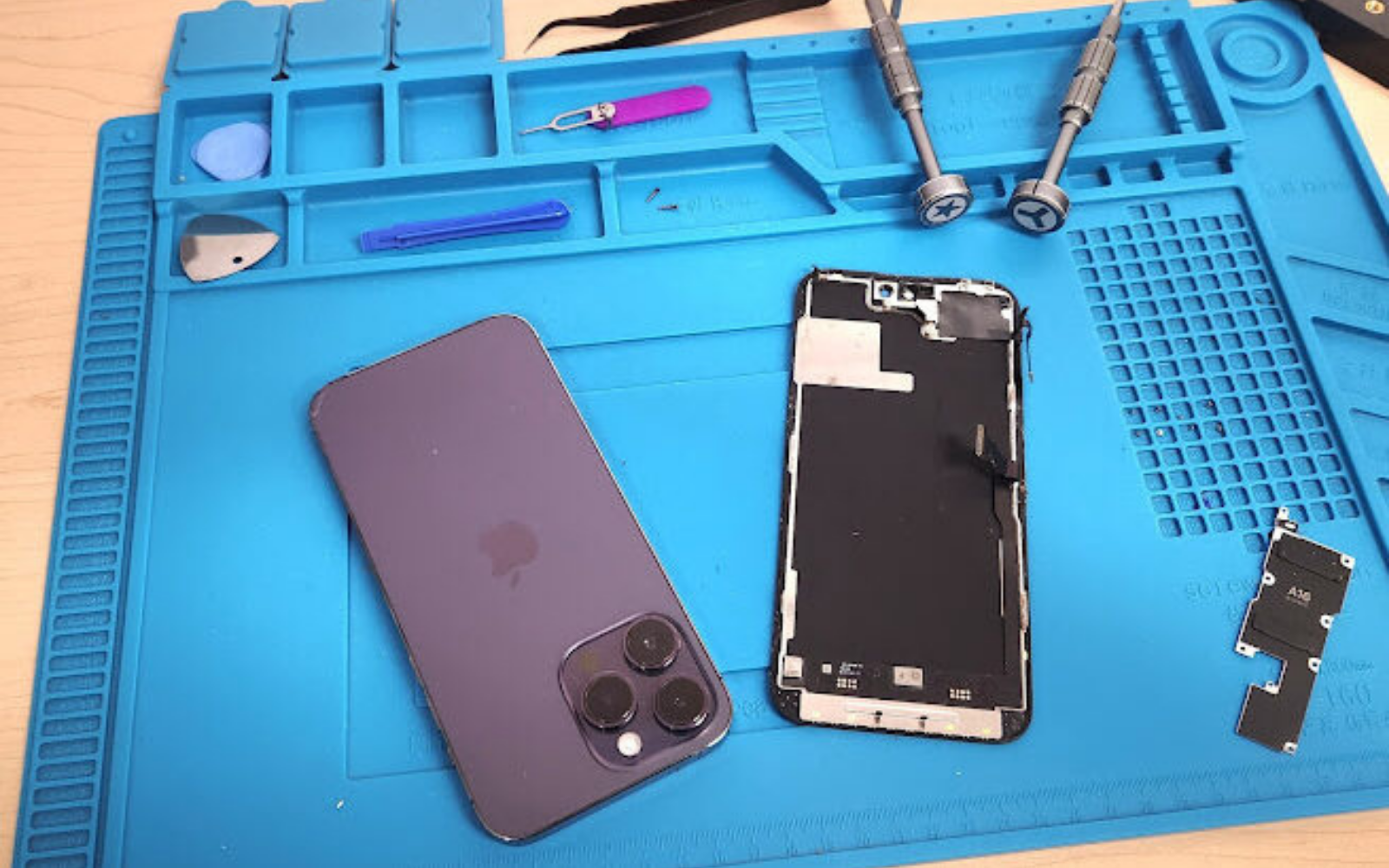
An IC transfer exists to solve a commercial problem: keep the original display information with the phone, fit a new panel, and avoid the parts notification the customer would otherwise see. Most of the time it works. When it fails, it fails in the most confusing way possible, because the screen lights up perfectly and the touch layer is completely dead.
That combination sends technicians looking for a damaged connector or a faulty part. The cause is usually neither. It is a calibration mismatch created by moving a driver IC between two panels that were characterised separately.
<h2>Why a genuine-to-genuine swap can still fail</h2>
The reasoning that leads technicians into this problem is sound. If both panels are genuine, and both came out of working iPhones of the same model, the electronics ought to be compatible. Across most component-level work that assumption holds.
Display assemblies are the exception, because a genuine panel is not a generic part built to a reference design. The OLED panel, the touch layer and the driver circuitry are characterised together as a matched system, and the calibration data belongs to that specific combination. Apple’s own description of what counts as a <a href="https://support.apple.com/en-gb/103256" rel="nofollow">genuine iPhone display</a> reflects that the display is treated as an assembly rather than as interchangeable parts.
<h2>What is IC transfer on an iPhone screen?</h2>
Moving the original driver chip onto a new panel.
IC transfer means taking the driver integrated circuit from the customer’s original display and fitting it to a replacement panel, so that the phone continues to see the display information it expects. It is used to avoid a parts notification, to preserve True Tone where the technique supports it, and sometimes to keep a genuine display in service instead of fitting a complete aftermarket assembly.
The work is delicate, requires proper tooling and depends on the replacement panel being designed to accept a transferred chip. Assemblies marketed as IC-removable are built for this; standard assemblies are not. The economics only work when the value of keeping the original display information is worth more than the bench time, which is usually the case on current Pro models and rarely the case on older handsets.
<figure class="image-block"><a href="https://www.digi4u.co.uk/iphone_0_1_2/iphone-screen"><img src="https://www.digi4u.co.uk/image/cache/catalog/6000-6999/6512/DD%20Replacement%20Soft%20OLED%20IC%20Removable%20For%20iPhone%2016%20Plus%20With%20Tools-500×500.jpeg" alt="DD soft OLED replacement screen assembly for iPhone 16 Plus supplied with tools, designed to accept a transferred driver IC" width="500" height="500" /></a><figcaption>An IC-removable soft OLED assembly for iPhone 16 Plus. Panels built for transfer are the only ones this technique should be attempted on.</figcaption></figure>
<h2>Why does IC transfer sometimes produce no touch at all?</h2>
Because the touch baselines belong to the panel, not to the chip.
When display and touch functions are separated across the driver, they do not degrade equally. The display side tolerates a wider range, because drive voltages and timing can be handled across a spread of values. The touch side depends on precise per-channel baselines captured during manufacture, and those baselines account for the capacitance behaviour of one specific panel.
Move the IC to a panel produced elsewhere, with different materials and different process tolerances, and the display can still be driven correctly while touch has nothing valid to calibrate against. That is the mechanism behind a symptom that looks contradictory on the bench: a perfect image with completely dead touch. The result is reported as intermittent rather than certain, which is exactly what you would expect from a tolerance problem rather than a binary incompatibility.
<h2>What do repairers report when an IC is moved between panels?</h2>
A consistent shape of failure, at an inconsistent rate.
The pattern reported by technicians working on high-end iPhone models is consistent in form. The assembly powers on. The image is correct, sometimes indistinguishable from the original. Touch does not respond, or responds only across part of the display. Returning the IC to its original panel restores touch.
The frequency varies with the specific model pair, which panel was fitted where, and the tooling used. Treat the rate as unknown for your own shop until you have logged your own results, because a failure rate quoted by someone using different equipment and different panel batches tells you very little about your bench.
<h2>Which checks isolate the cause before you commit to a transfer?</h2>
Establish the baseline before disturbing anything.
Almost every wasted hour in this procedure comes from starting without a known-good baseline. Confirm the donor IC and its original panel work together before you take the chip off, so that a later failure can be attributed to a specific change rather than to the assembly as a whole.
Then work through the sequence in order. Confirm the source combination functions. Identify the panel you are transferring onto and where it came from. Test the finished assembly on the device before any adhesive goes down. And if it fails, reverse the transfer, because the direction the fault follows tells you whether the IC or the panel is responsible. That one test converts a guess into a diagnosis, and it costs you ten minutes rather than a replacement panel.
<table>
<thead>
<tr>
<th>What you observe</th>
<th>Most likely cause</th>
<th>Next step</th>
</tr>
</thead>
<tbody>
<tr>
<td>Image correct, touch completely dead</td>
<td>Touch baseline mismatch between IC and panel</td>
<td>Reverse the transfer and retest</td>
</tr>
<tr>
<td>Image correct, touch works on part of the display</td>
<td>Partial calibration mismatch, or touch flex damaged during transfer</td>
<td>Inspect the touch flex, then reverse</td>
</tr>
<tr>
<td>Image incorrect as well as touch</td>
<td>Transfer workmanship rather than panel pairing</td>
<td>Recheck the soldered joint and alignment</td>
</tr>
<tr>
<td>Works cold, fails when warm</td>
<td>Marginal bond or marginal calibration under thermal load</td>
<td>Retest after ten minutes of use before sealing</td>
</tr>
</tbody>
</table>
<h2>What should you test after the transfer, before you seal the phone?</h2>
Touch across the entire display, cold and warm.
Connect the assembly and run a continuous trace across the full display, paying attention to the outer few millimetres and the corners, where marginal faults appear first. Then let the phone run for ten minutes and repeat the trace. A fault that only appears once the assembly is warm is a fault the customer will find within a day.
Do not seal the device until both passes are clean. Resealing and reopening costs more than the extra ten minutes of testing, and it is the step most often skipped when the shop is busy.
<h2>How do you record and price IC transfer work?</h2>
Price it as diagnostic-dependent, not as a straight screen swap.
An IC transfer carries a risk that a standard replacement does not, because a panel and a chip can be individually correct and still not work together. Quoting it as a straightforward screen replacement means absorbing that risk silently.
Quote it separately, keep one known-good panel of each origin for the models you transfer most often, and log the outcome of every attempt. Without a log you cannot tell whether a run of failures means a bad batch, a tooling problem or a run of unlucky pairings, and you will end up changing suppliers on a hunch.
<h2>When should you skip the IC transfer entirely?</h2>
Tooling determines whether this is a viable service line at all. The work needs a stable soldering setup with fine tip control, a way to hold the assembly flat and immovable, magnification good enough to inspect the joint before power is applied, and a bench supply so the first test is not run off the device’s own battery. Attempting a transfer without magnification is the most common reason a joint passes a visual check and fails electrically.
It also helps to keep one known-good panel of each origin for the models you transfer most. When a fault appears you can move the suspect chip onto a panel you trust, which separates a chip problem from a panel problem in one test rather than in an afternoon of substitution. That single spare reduces the diagnostic time on every failed transfer you handle.
When the logistics matter more than the parts notification.
Some jobs are better served by a matched assembly. If the panel’s origin is unknown, if the customer needs the phone back the same day, or if the repair carries a long warranty you would rather not expose to a second variable, a standard matched assembly is the lower-risk choice.
For shops selling to consumers in the UK, be clear about what you fitted and what it means. Statutory rights for retail customers are set by the <a href="https://www.legislation.gov.uk/ukpga/2015/15/contents" rel="nofollow">Consumer Rights Act 2015</a>, and obligations around the safety of goods you place on the market sit with the <a href="https://www.gov.uk/government/organisations/office-for-product-safety-and-standards" rel="nofollow">Office for Product Safety and Standards</a>. A written statement of the part fitted and the warranty attached to it is the simplest protection for both sides.
<h2>What do you tell the customer when an IC transfer fails?</h2>
Explain the pairing in one sentence and show them the failure.
A technician understands immediately why a display can be perfectly lit and completely unresponsive. A customer does not, and the same information can sound like an excuse. Keep it concrete: the panel and its control chip are matched as a pair at the factory, this combination did not respond to the pairing test, and a different assembly is being fitted rather than releasing a phone that is likely to come back.
Two details make that land. Say it while the test is running, not after the customer has waited an extra hour. And show the failure, because a live display that ignores every tap is self-explanatory. Apple’s guide to <a href="https://support.apple.com/en-gb/102658" rel="nofollow">iPhone Parts and Service History</a> is worth keeping open while you explain what the device will show about the part afterwards, and Apple sets out its own route and pricing in <a href="https://support.apple.com/en-gb/iphone/repair/screen-replacement" rel="nofollow">Apple Service and Repair for iPhone Screens</a> for customers weighing the alternative.
<figure class="image-block"><a href="https://www.digi4u.co.uk/Replacement_Soft_OLED_Diagnostic_Screen_For_iphone_17_Pro_Max"><img src="https://www.digi4u.co.uk/image/cache/catalog/iPhone%2017/Diagnostic%20%20Replacement%20Soft%20OLED%20Screen%20%20For%20iPhone%2017%20Pro%20Max%20%E2%80%93%20Professional%20Use-500×500.png" alt="Diagnostic soft OLED replacement screen for iPhone 17 Pro Max intended for professional repair use" width="500" height="500" /></a><figcaption>Diagnostic soft OLED assembly for iPhone 17 Pro Max. Pro-model repairs are where IC transfer usually earns its bench time.</figcaption></figure>
<div class="faq">
<h2>FAQ</h2>
<p class="faq-q">Why is my iPhone screen not working after screen replacement?</p>
<p class="faq-a">If the image is correct and touch is completely dead, the most likely cause on a repaired iPhone is a mismatch between the driver IC and the panel, which happens when the IC is moved between panels that were calibrated separately. Check the display and touch flex connectors first, then reverse the transfer. If the fault follows the IC rather than the panel, the pairing is the problem.</p>
<p class="faq-q">Why is my phone not responding to touch after screen replacement?</p>
<p class="faq-a">Touch failing while the image is perfect points at the touch layer or its calibration rather than the display. On an IC transfer the panel and the IC carry separate touch baselines that were captured during manufacture, and those baselines do not always transfer between panels from different production sources. Reversing the transfer is the fastest way to confirm it.</p>
<p class="faq-q">How do I fix an unresponsive iPhone touch screen after a repair?</p>
<p class="faq-a">Reconnect both flex connectors and test again before assuming the worst. If touch is still dead and the image is fine, reverse the IC transfer so the original driver returns to its original panel and retest. If touch returns, the pairing was the cause. If it does not, inspect the touch flex for damage from the transfer work.</p>
<p class="faq-q">Can I do an IC transfer and still keep the True Tone and parts history clean?</p>
<p class="faq-a">Carrying the original display information across is one of the reasons technicians attempt the transfer in the first place. Apple documents how a device reports replaced displays in iPhone Parts and Service History, and any claim about avoiding a notification should be tested on the specific model and iOS version in front of you before you promise it to a customer.</p>
</div>
IC transfer is a controlled risk rather than a reliable shortcut. Establish the baseline before you touch the chip, test the finished assembly cold and warm before you seal it, and record what happened against the panel origin. Shops that do those three things stop losing panels to a fault that was never a faulty part, and they gain a defensible reason to fit a genuine display where the customer values it.
<div class="cta">
<strong>Need assemblies that accept a transferred IC?</strong> Digi4u stocks IC-removable soft OLED screens and diagnostic assemblies for UK repair shops, with trade pricing, same-day dispatch and up to 12 months warranty. Tell us the model and we will confirm what is available.
<a href="https://www.digi4u.co.uk/wholesale">Open a trade account</a></div>
Part of the Screen Grades & Warranty guide.