


Samsung Galaxy Parts: Matching the Model Code Before You Order
Need this part? We stock tested replacement parts with same-day UK dispatch and a 12-month warranty.
Samsung reuses model names across generations and across markets, and a part ordered against the name rather than the code will sometimes fit and sometimes not. The difference is not visible on the packaging, and by the time it shows up the customer’s phone is open.
The model code is the ordering key. Understanding what the parts of that code mean is the whole discipline, and it takes less time than processing one return.
Why the Galaxy name is not a specification
Because one name covers several hardware variants.
A Galaxy A54 sold in the UK and an A54 sold in another market can differ in panel supplier, battery part number and connector arrangement while sharing the same marketing name and the same screen size. Samsung builds for regional networks and regional supply chains, which is why the same name appears on more than one hardware configuration.
For a repair shop that means the name identifies the product family and nothing more. Two devices with the same badge on the box can take different parts, and the only reliable way to tell them apart is the model code printed in the settings.
How do you read a Samsung model code?
By treating each segment as information rather than noise.
The code begins with SM, followed by a letter indicating the family and a number indicating the generation within it. What follows identifies the specific variant, and the suffix at the end distinguishes regional builds and carrier versions. Two codes that differ only in the final segment can be physically different devices.
Find the code in Settings under About phone, and read the whole thing rather than the first part. The segment that looks least important is usually the one that separates the part you need from the part that will not fit.
-600x315w.jpg)
Which parts change between variants?
Panels, batteries and connector assemblies are the ones that catch people out.
Display assemblies are the most common source of problems, because panel suppliers can differ between variants and the connector arrangement follows the panel. Batteries are the second, particularly where a variant was built with a different capacity or a different connector position. Charging port assemblies are the third, since they carry the microphone and antenna connections on several models.
Parts that are usually stable across variants tend to be the mechanical ones: frames, camera lens glass, speaker modules and small brackets. That is a useful rule of thumb rather than a guarantee, and it is worth confirming on the specific pair of codes rather than assuming.
| Part | Likely to differ between variants | What to confirm |
|---|---|---|
| Display assembly | Often | Full model code, and whether it is a complete assembly |
| Battery | Often | Battery part number as well as the phone model |
| Charging port assembly | Sometimes | Connector layout and whether the microphone is included |
| Camera modules | Sometimes | Position on the device and the variant |
| Frames and brackets | Rarely | Still confirm against the code |
How do you confirm the right part before ordering?
Read the code, then check the supplier listing carries the same code.
The listing should name the model code in the compatibility detail rather than only in the title. A listing that says “Samsung A54 screen” without the suffix is not specific enough to order from, and the part that arrives may be right for one variant and wrong for the customer’s device.
Where the code is ambiguous or the listing is vague, ask before ordering. That question takes minutes; a return on a bonded display assembly takes longer and may not be possible at all once the adhesive has been opened.
The same logic applies to Apple hardware, and the approach in our guide to matching MacBook parts to the chassis follows the identical principle: order against the number, not the name.
How does this affect what you hold in stock?
Hold the variants you see, and order the rest.
Because variants fragment demand, holding Samsung parts deeply is riskier than holding iPhone parts. The practical approach is to stock consumables and common mechanical parts across the models you repair weekly, and to order displays and batteries per job against the confirmed code.
Where a shop sees a steady flow of one Galaxy model, a targeted stock position is worth it for the same reason it is on iPhone: it turns a two-day turnaround into a same-day one. The difference is that the position has to be defined by code rather than by name, or the stock will not match the devices coming through the door.
What should you check on arrival?
The code on the part, and the connector against the original.
Check that the part carries the same model code in its listing or label, then compare the connector profile against the original before anything is bonded or fitted. On a display assembly that comparison is the last cheap moment, because once the adhesive is used the part is no longer returnable in most cases.
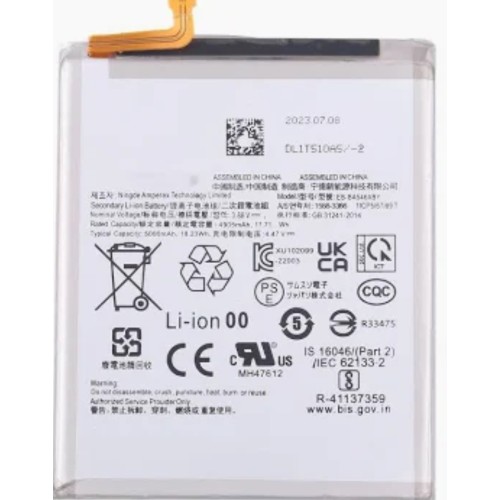
On batteries, compare the part number as well as the phone model. Samsung batteries are commonly identified by their own code, and matching on the phone model alone does not guarantee the correct cell.
What does the customer need to know?
That the repair depends on the code, and that the code is not on the screen.
Customers describe their phone by the name on the box or the colour, and neither identifies the variant. Asking them to read the model code from settings before you quote is faster than taking the device in, opening it, and discovering that the part you have does not fit.
Where the customer cannot find the code, the IMEI or the code printed in the SIM tray area can help confirm the variant. What the device reports about its own parts, where it can, follows the pattern Apple documents for parts and service history, and the same caution applies: it is one input rather than a verdict.
What about warranty and compliance?
Two frameworks apply, and they are separate.
For retail customers in the UK, the statutory rights you must honour sit on top of your own warranty and are set by the Consumer Rights Act 2015. Obligations around the safety of goods you place on the market sit with the Office for Product Safety and Standards.
Where a replaced part is disposed of, electrical and electronic waste is covered by the Waste Electrical and Electronic Equipment Regulations 2013, and battery handling in a workplace falls under the Health and Safety Executive. Samsung publishes its own service and support routes at Samsung UK support, which is the reference a customer will use if they ask for the manufacturer’s option.
What should you record on the job sheet?
The full model code, the part number and the variant check.
Record the complete model code rather than the name, the part that was fitted with its own reference, and the date. Where you confirmed the variant against the customer’s device before ordering, note that too, because it explains why the part was ordered the way it was if a query arises later.
That record is also what builds a useful internal reference over time. After a few months of Galaxy work, a shop knows which codes it sees and which parts it actually needs to hold, and that knowledge comes from the job records rather than from a catalogue.
How does the model code change your stock decision?
It narrows the shelf and raises the value of the parts you do hold.
A shop that stocks Galaxy parts by name ends up with a position that half-fits the devices coming through the door, and the half that does not fit sits there. A shop that stocks by code holds fewer lines, but the lines it holds actually get used, which means the capital tied up in stock turns over faster.
The practical method is to record the full code on every Galaxy job for a couple of months. The pattern that emerges is far more useful than any general list of popular models, because it reflects the devices in your own catchment rather than a national average. From that record, the stock position almost writes itself.
Where two codes share a part, that is worth noting in your own reference table. Some Galaxy variants are fully interchangeable on panels and batteries, and knowing which pairs interchange is a genuine efficiency: it lets one part cover two entries on the shelf without guessing.
What makes this worth doing now rather than later is that Galaxy work is common and the mistakes are expensive. A wrongly ordered display assembly is the largest single loss in a normal week, and almost every one of those losses traces back to an order placed against a name rather than a code.
What is the one habit that prevents a wrong Galaxy part?
Ask for the model code before you quote, not after.
That single question at booking time tells you which variant the customer has, whether the part is in stock, and whether the job is worth taking. A shop that asks it on every Galaxy enquiry stops ordering wrong parts within a month, and the customer experience improves at the same time because the quote is accurate. The codes are not complicated once they are treated as the specification they are.
FAQ
How do I find my Samsung Galaxy model number?
Open Settings, then About phone, and look for the model number. On most Galaxy devices it is a code beginning with SM, such as SM-A546B. That code identifies the exact variant, which is what parts are matched against. The marketing name on the box covers several variants and is not precise enough to order from.
Why do Samsung parts not fit even when the model name matches?
Because one marketing name covers several regional variants, and those variants can use different panels, batteries or connectors. An A54 sold in one market is not necessarily the same hardware as an A54 sold in another. The suffix on the model code is what separates them, which is why ordering by name alone produces parts that are correct in size and wrong in fit.
Can I use a Samsung screen from another region?
Sometimes, and it depends on whether the two variants share the same panel and connector. Some regional variants are fully interchangeable; others are not, and the difference is not visible until the part is offered up to the frame. Confirm the full model code including the suffix before committing to a stock position.
Where can I find genuine Samsung spare parts in the UK?
Samsung operates its own support and parts channels, and the independent trade is served by parts distributors who stock aftermarket and pulled assemblies. Whichever route you use, order against the full model code and check whether the part is a complete assembly or a component before it arrives.
Galaxy work rewards one habit: read the full model code and order against it. That single step separates the variant, identifies the part, and prevents the return that a name-based order produces. The codes look like noise until you treat them as the specification, and then they are the fastest part of the job.
Repairing Galaxy devices? Digi4u supplies Samsung screens, batteries, charging ports and small parts to UK repair shops, with trade pricing, same-day dispatch and up to 12 months warranty. Send us the full model code and we will confirm what is in stock.