

The Rise of No-Solder Face ID Repair for iPhone 13–15: A Major Shift in the Mobile Repair Industry
Need this part? We stock tested replacement parts with same-day UK dispatch and a 12-month warranty.
For years, Face ID failure on Apple iPhone 13 to iPhone 15 devices has been considered one of the most difficult repairs in the smartphone repair industry.
Traditional repair methods often required:
- Microsoldering
- Dot projector chip transfer
- Precision alignment under a microscope
- High-risk board-level work
In many cases, one mistake could permanently disable the entire TrueDepth system.
But in 2025 and 2026, a new repair approach began gaining attention across the repair industry: No-Solder Face ID Repair.
This new method is already changing how independent repair shops, refurbishers, and mobile technicians approach Face ID restoration on modern iPhones.
Why Face ID Repairs Became So Difficult on iPhone 13–15
Since the launch of the Apple iPhone 13 series, Apple has significantly increased hardware pairing and security protections tied to the TrueDepth camera system.
Early reports from repair communities showed that even a simple display replacement could disable Face ID functionality if certain paired components were disturbed.
The challenge comes from the fact that Face ID is not a single component. It is an integrated biometric system involving:
- Dot Projector
- Infrared Camera
- Flood Illuminator
- Proximity Sensor
- Logic board encryption pairing
Each component communicates with encrypted calibration data stored within the device.
That is why traditional Face ID repair has historically required advanced microsoldering techniques and expensive equipment.
What Is “No-Solder” Face ID Repair?
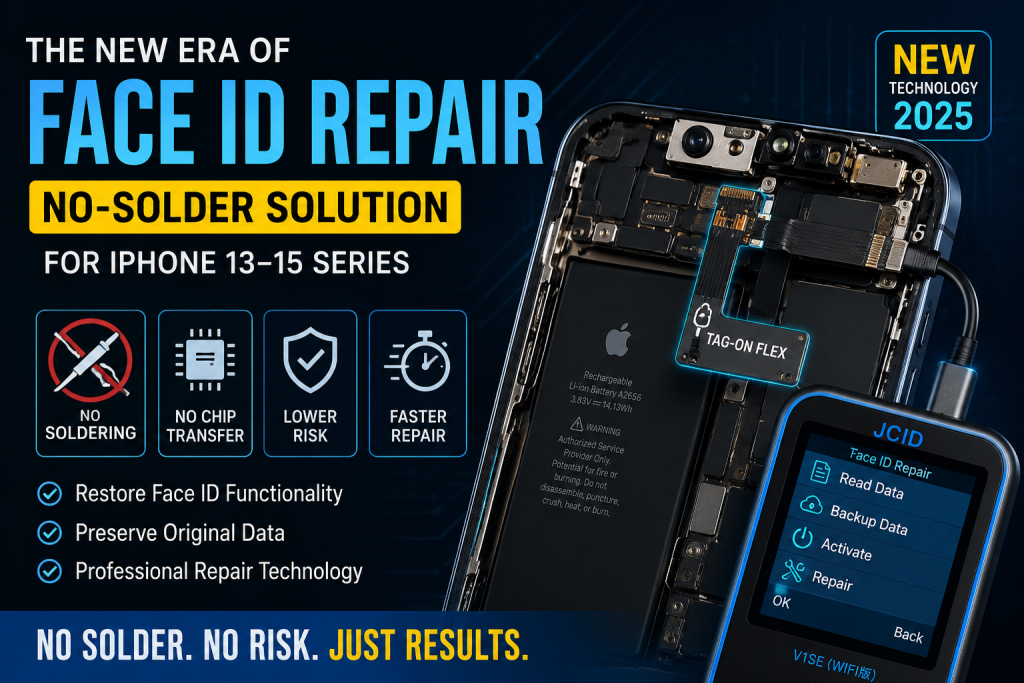
The new no-solder repair method focuses primarily on repairing communication issues related to the Dot Projector system without physically transferring or soldering chips.
Instead of removing ICs from the original module, technicians use:
- Specialized programmers
- Tag-on flex cables
- Activation boards
- Cloud-based data backup tools
The process allows repair shops to preserve original encrypted data while restoring communication between the Face ID components and the device.
Importantly, these solutions are designed for legitimate repair scenarios only and are not intended to bypass activation locks or unlock stolen devices.
How No-Solder Face ID Repair Works (iPhone 13–15)
Core Principle
No-solder Face ID repair does not physically repair or replace damaged Face ID components.
Instead, it focuses on restoring communication between the TrueDepth system and the logic board.
Repair Process Overview
The repair is completed through a structured digital + hardware-assisted workflow:
- Data Reading
The programmer reads the original Face ID calibration and pairing data from the device. - Data Backup
Critical Face ID information is temporarily saved to avoid data loss. - Tag-on Flex Connection
A Tag-on flex cable is installed to bridge communication between modules. - Activation
The system re-initializes Face ID recognition through the repair tool. - Function Testing
Face ID unlock and TrueDepth functions are tested after repair.
Key Mechanism
- Restores communication, not hardware
- Relies on original Face ID module integrity
- Works mainly for data or calibration-related failures
Why This Technology Matters for Repair Shops
This repair method represents one of the biggest changes in Face ID repair over the past several years.
1. Lower Technical Barrier
Traditional Face ID restoration required highly specialized board-level repair skills.
With no-solder solutions, many repair shops can now perform certain Face ID repairs without advanced microsoldering experience.
That means:
- Faster technician training
- Reduced repair risk
- Higher repair accessibility
2. Faster Turnaround Time
Traditional Face ID chip transfers could take hours.
The new tag-on repair workflow can often be completed much faster, especially for experienced technicians using dedicated programmers.
For repair businesses, this can improve:
- Customer turnaround time
- Repair volume
- Profit margins
3. Reduced Hardware Risk
One of the biggest dangers in traditional Face ID repair is damaging the Dot Projector or optical alignment during chip transfer.
Because the no-solder method avoids removing critical ICs, the risk of permanently destroying the original module is significantly lower.
Which Face ID Problems Can Actually Be Repaired?
This is where many customers misunderstand Face ID repair.
No-solder repair is not a universal solution.
It is primarily effective for certain Dot Projector communication or calibration-related failures.
Commonly Repairable Issues
| Problem | Repair Possibility |
|---|---|
| Dot Projector communication issue | High |
| Face ID “Not Available” error | Partial |
| Minor drop damage | Partial |
| Some calibration failures | High |
| Certain IC communication faults | High |
Problems That Often Cannot Be Fixed
| Problem | Repair Possibility |
|---|---|
| Flood Illuminator damage | Low |
| IR Camera hardware failure | Low |
| Severe water corrosion | Low |
| Torn flex cables | Low |
| Missing original Face ID module | Usually impossible |
Repair discussions on Reddit and professional repair forums continue to show that successful Face ID restoration still depends heavily on the condition of the original paired hardware.
Apple’s Repair Policies Are Also Changing
Interestingly, the broader repair industry landscape is also evolving.
Recent reports suggest Apple is gradually loosening some repair pairing restrictions through newer versions of its Repair Assistant system and expanded self-service repair support.
This reflects growing global pressure from:
- Right-to-repair legislation
- Independent repair advocates
- Consumer demand for affordable repairs
- Sustainability initiatives
At the same time, Apple continues to maintain strict security protections around biometric hardware.
As a result, independent repair solutions like no-solder Face ID restoration continue to gain popularity among repair professionals.
The Growing Demand for Face ID Repair
The demand for Face ID repair continues to rise for several reasons:
Longer Device Lifespans
Many users are keeping devices like the Apple iPhone 13 and Apple iPhone 14 for longer periods instead of upgrading annually.
Higher Replacement Costs
Modern iPhone replacement costs continue to increase, making repairing a more attractive option.
Expanding Refurbishment Industry
Refurbishers and second-hand phone resellers increasingly rely on restoring Face ID functionality to maximize device resale value.
A fully functional Face ID system can significantly improve the value and marketability of refurbished iPhones.
The Future of Face ID Repair
No-solder repair technology does not eliminate the need for advanced technicians.
Complex TrueDepth hardware failures will still require deep diagnostic experience and microsoldering expertise.
However, the technology is clearly shifting the industry toward:
- Faster repairs
- Lower repair risk
- Wider repair accessibility
- More scalable repair workflows
For independent repair shops, this creates new opportunities to offer premium repair services that were previously considered too risky or too specialized.
Final Thoughts
The introduction of no-solder Face ID repair for iPhone 13–15 devices marks a major evolution in the mobile repair industry.
What was once considered an extremely high-risk board-level repair is gradually becoming more accessible to independent repair shops and refurbishers worldwide.
Although the technology still has limitations, it is already helping technicians restore Face ID functionality more efficiently while reducing the risks associated with traditional microsoldering methods.
As repair tools continue to improve and repair policies evolve, Face ID restoration may become one of the fastest-growing segments of the smartphone repair industry over the next few years.