


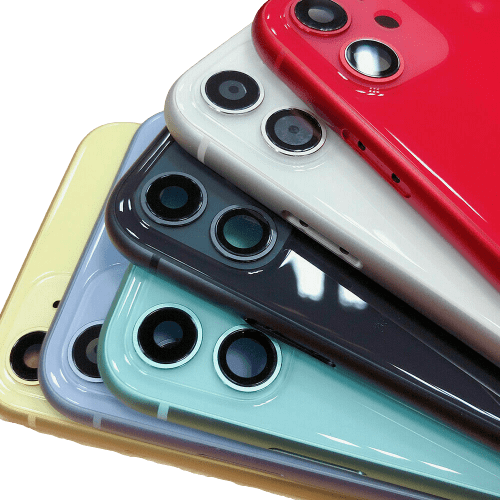
The phone that arrives with a shattered back is rarely the expensive part of the job. The expensive part is what happens to the wireless charging coil, the camera lens cover and the frame when the rear glass is separated, because on an iPhone 11 the back is an assembly rather than a window. This listing is a metal frame, back chassis and rear glass cover replacement for the iPhone 11, supplied in six colours, and the two questions that decide whether it is a straightforward job or a two-visit repair are whether the customer’s original parts transfer cleanly and whether the rear housing is being bought complete or as glass alone.
(Last modified date: October 2, 2026)
What is actually being replaced on an iPhone 11 back?
Glass, frame or both, and the price difference is not small.
Apple lists the iPhone 11 with a glass back and wireless charging that works with Qi chargers, which means the rear of the phone is not a cosmetic panel: it carries the charging coil behind it and the camera lens cover through it. A damaged back therefore splits into three repair shapes, and quoting one when the customer needs another is how a job loses its margin.
| Approach | What is replaced | What has to be transferred | Typical fit |
|---|---|---|---|
| Rear glass only | The broken glass, re-bonded to the original frame | Everything: coil, flash diffuser, lens cover, frame | Clean, single-crack damage on a straight frame |
| Housing with frame, without small parts | Frame, chassis and back glass as one unit | Charging coil, flash, camera lens cover, buttons and flexes | Bent or deformed frames, or heavy impact damage |
| Housing supplied with parts | Frame, chassis, back glass and the small parts already fitted | Only the mainboard assembly and the parts the customer’s phone keeps | Trade work where bench time matters more than part cost |
The listing this article refits is the third shape in its trade form: a metal frame, back chassis and rear glass cover in a choice of six colours. Housing sold with the small parts fitted is the version that keeps a workshop’s handling time down, which is why the choice between the two is a commercial decision rather than a technical one.

Where does the risk sit in the job?
In the removal, and in two parts that go with it.
The rear glass is bonded across its whole surface, so it comes away with heat, with a laser, or with a combination of the two, and both methods put stress on a frame that is already the reason the customer is here. The two parts that most often do not survive are the wireless charging coil, which is a thin assembly sitting directly behind the glass, and the camera lens cover, which has to be lifted without cracking the camera’s own window. A third, smaller risk is the flash diffuser, which is easy to lose and hard to source on its own.
What makes this a cost question rather than a technique question is that a complete housing sidesteps all three. If the small parts are already fitted on the replacement and the old ones are not reusable, the housing version is cheaper than the glass-only version plus two specialist parts and an hour of handling. Where the job also involves the camera window, the decision is the one set out in choosing between a camera lens and a camera module.
What does the job cost, and where does the money go?
Break it into time, parts and risk, and the total stops being a guess.
Take a shop on £35 an hour. A glass-only replacement on a clean frame runs about 75 minutes: warm-up and separation, frame clean-up, new adhesive, lens cover transfer, then the wireless charging test before the phone is closed. That is £43.75 of labour, a glass kit at £12, and a £4 allowance for adhesive and consumables: roughly £59.75 before overheads.
A complete housing with the small parts fitted runs about 50 minutes, because the most delicate transfers have already been done by the supplier: £29.17 of labour and a housing at £38 gives £67.17. The housing job costs about £7.42 more and returns 25 minutes to the bench. On a day with three of these, the housing version frees over an hour for other work, which is the comparison that matters. These are modelled figures with stated assumptions; put your own hourly rate, handling times and part costs in and the answer may point the other way.
What must be tested before the phone is closed?
Wireless charging, the camera, the flash and the frame fit.
Three of those four are quick and one is not obvious. Place the phone on a Qi charger and confirm it charges at a sensible rate before the adhesive is set, because a coil that has been nicked or shifted will still look correct from the outside. Photograph the rear camera in good light and check for dust and for a halo, which indicates a lens cover seated off-axis. Fire the flash and check for a hot spot or a leak around the diffuser. Then check the frame against a flat surface, because a housing fitted to a bent mid-frame will lift again within days.
Two expectations also need to be set with the customer at handover. Water and dust resistance is not restored: an opened iPhone should be described honestly rather than assumed to be sealed, and the same wording applies to any repair involving a seal. And the appearance of a replacement housing is a colour match to the original specification, not to a faded two-year-old phone, which is why the colour should be chosen with the device on the counter.
What should be asked of the supplier?
- Whether the housing is supplied with the small parts fitted, and exactly which parts are included.
- The part number and the colour code, so a repeat order matches the first.
- Whether the camera lens cover and flash diffuser are included or must be transferred.
- The batch reference, so a fitment fault can be traced against every unit from the same run.
- Written DOA terms, including who pays return carriage and how long the window stays open.
The returns process that makes those answers useful is described in building a parts returns process, and the pre-seal testing habit in how to test a replacement screen before you seal the device applies to the rear of the phone as much as to the front.
What is in a housing kit, and what has to transfer?
Three levels of completeness, and the difference is entirely about handling time.
As a reference point on price, the iPhone 11 rear housing listed with its small parts and battery glue is £19.99 in red, and the general back cover category starts at £16.99. What that buys varies by listing, so the question to ask is which of the following the kit contains:
- Frame, chassis and glass as one unit. The structural shell, ready to receive the phone’s internals.
- Camera lens ring and flash diffuser. Small, easy to lose and difficult to source separately, which is why kits that include them save the most time.
- Wireless charging coil and MagSafe magnet array. Either pre-fitted or transferred from the original, and this is the part that determines whether the phone still charges on a pad.
- Buttons and their flexes. Power, volume and mute, which are pressed into the frame rather than glued.
- The battery adhesive. Not a part you see, but the reason a housing listed “with glue” is the more useful purchase on a phone that is being reassembled.
Heat or laser: how is the back glass actually separated?
Two methods, and the choice is about the panel you are trying not to damage.
The traditional route is heat: warm the whole rear surface with a heat mat — the CPB CP320 is listed at £59.99 — and work a thin tool under the glass once the adhesive releases. It is cheap, it needs nothing beyond the mat, and it puts a slow, even load on a frame that is often already distorted by the impact that broke the glass.
The other route is a laser separating machine, such as the TBK-958B, which cuts the adhesive bond along a programmed path. It removes most of the mechanical load from the frame, at the cost of a machine, a bench and a learning curve. On a shop doing back glass weekly, the laser is a throughput purchase rather than a quality one — the same argument as the screen removal machine versus a suction cup.
Whichever method is used, the parts at risk are identical: the coil directly behind the glass, the lens ring, and the frame itself.
How do you check wireless charging after the job?
Before the adhesive is set, and with the phone switched on.
Apple lists the iPhone 11 as charging wirelessly with Qi chargers, and the coil that does the work sits immediately behind the rear glass — which is the part being replaced. Place the phone on a Qi pad and confirm it starts charging within a few seconds and continues past the first minute. A coil that has been nicked, creased or displaced will often still look correct from the outside and will still let the phone power on, so this is a test that has to be deliberate.
Two related checks belong in the same five minutes: photograph the rear camera in good light and look for dust behind the lens cover or a halo around bright points, and fire the flash to check the diffuser is seated. Both are the kind of fault a customer notices on day one and attributes to the repair.
What goes wrong with a back glass replacement?
Four failure modes, in order of how often they cause a return.
- Lifting glass or a panel that sits proud. Almost always adhesive applied over residue, or a frame channel that was not cleaned back to bare metal.
- Wireless charging that stops working. The coil, transferred or pre-fitted, is the usual cause; the fault appears on the pad rather than on the screen.
- Camera dust or a misaligned lens ring. Both happen during the transfer, and both are permanent once the rear is sealed.
- A bent frame that stays bent. If the original frame was distorted, a glass-only replacement will not straighten it; that job needs the complete housing.
Water and dust resistance is the fifth expectation to manage rather than a fault: any repair that opens the phone breaks the factory seal, and fresh adhesive gives a chance of restoring splash resistance, not the original rating. That wording should be agreed with the customer before the phone is closed, not after.
How do you choose the colour and finish?
On the phone, not on the listing.
The housing is a visible part, and a colour that looks right in a photograph will not necessarily match a handset that has spent two years in a case and a pocket. Two practical rules: order against the model and the colour code stated on the listing rather than against a colour name alone, and choose with the customer’s phone on the counter. Where the original frame is straight and the damage is glass-only, keeping the original frame removes the colour-matching question entirely, which is the strongest argument for repairing glass rather than replacing the whole rear.
References
- Apple Support: iPhone 11 technical specifications — glass back and wireless charging with Qi chargers.
- Apple Support: identify your iPhone model — confirming the model before a housing is ordered.
- Consumer Rights Act 2015 — the position on a retail repair.
FAQ
How much does it cost to replace the back of an iPhone 11?
It depends on whether the customer needs glass alone or a complete housing with the frame. A modelled example on this page puts a glass-only job at around £59.75 of cost and a housing job with the small parts fitted at around £67.17, using £35 an hour. Those are assumptions to be replaced with your own figures, not a quotation.
Does replacing the back housing affect wireless charging?
It can. Apple lists the iPhone 11 as charging wirelessly with Qi chargers, and the charging coil sits behind the rear glass, so a coil that is damaged or displaced during separation will stop charging even though the phone looks correct. Always test on a Qi charger before the adhesive is set.
Will the phone still be water resistant after a back glass repair?
Do not assume so. Any repair that opens a phone breaks the factory seal, and a replacement gasket and fresh adhesive are what give a chance of restoring it. Describe the result honestly rather than promising the original rating.
Can the rear glass be replaced without changing the frame?
Yes, provided the frame is straight. A glass-only replacement keeps the original frame and transfers the coil, lens cover and diffuser; a complete housing is the better answer when the frame is bent, and it avoids the most fragile transfers entirely.
How long does an iPhone 11 back glass replacement take?
Budget around 75 minutes for a glass-only job on a clean frame and around 50 minutes for a complete housing with the small parts already fitted. The difference is the component transfer, and it is why the more expensive part can be the cheaper job.
Choose the housing that matches the damage. Digi4u stocks iPhone 11 rear housings with the small parts fitted, in six colours, alongside the adhesives and bench tools the job needs.