iPhone 17 Teardown vs iPhone 16 Series: What’s Changed Inside and What It Matters for Phone Repair and Wholesale Parts Buyers

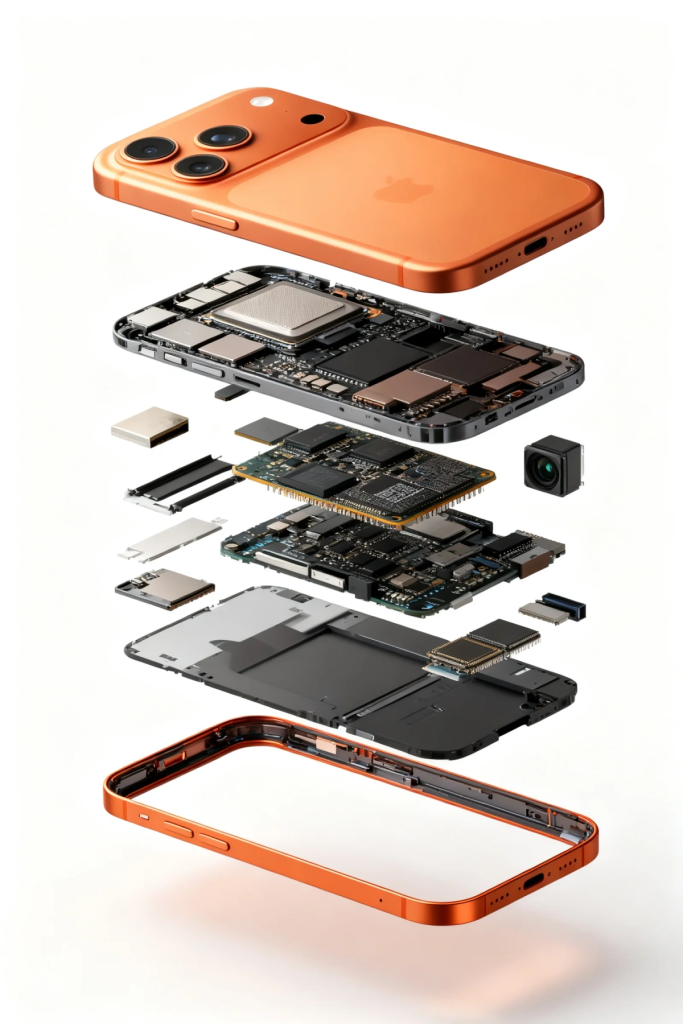
A full teardown comparison between the iPhone 17 and the iPhone 16 series reveals a clear continuation of Apple’s design philosophy: tighter integration, reduced internal spacing, and refined mechanical efficiency. While the overall architecture remains familiar, nearly every major subsystem shows incremental structural refinement.
This article presents a step-by-step teardown analysis,  focusing strictly on what is physically observable after disassembly.

1.Display Assembly: OLED Stack Compression

After removing the display assembly, the most immediate difference is the reduced thickness of the OLED stack in the iPhone 17.
Compared to the iPhone 16:
  • The OLED and touch layers are more tightly integrated
  • Overall module thickness is reduced
  • Clearance between the display and mid-frame is visibly smaller
This indicates a revised lamination and bonding strategy during manufacturing, with less internal tolerance reserved between layers.
iPhone_17_Pro-FEATURED-iphone_17_replacement_repair

2. Adhesive Layout: From Segmented to Continuous Bonding

Teardown inspection shows a clear change in adhesive strategy.

On the iPhone 17:

  • Adhesive around the display perimeter appears more continuous

  • Battery adhesive zones are more clearly defined

  • Adhesive width is more uniform

By contrast, the iPhone 16 series relies more heavily on segmented adhesive points. The shift suggests improved control over bonding geometry and structural consistency.

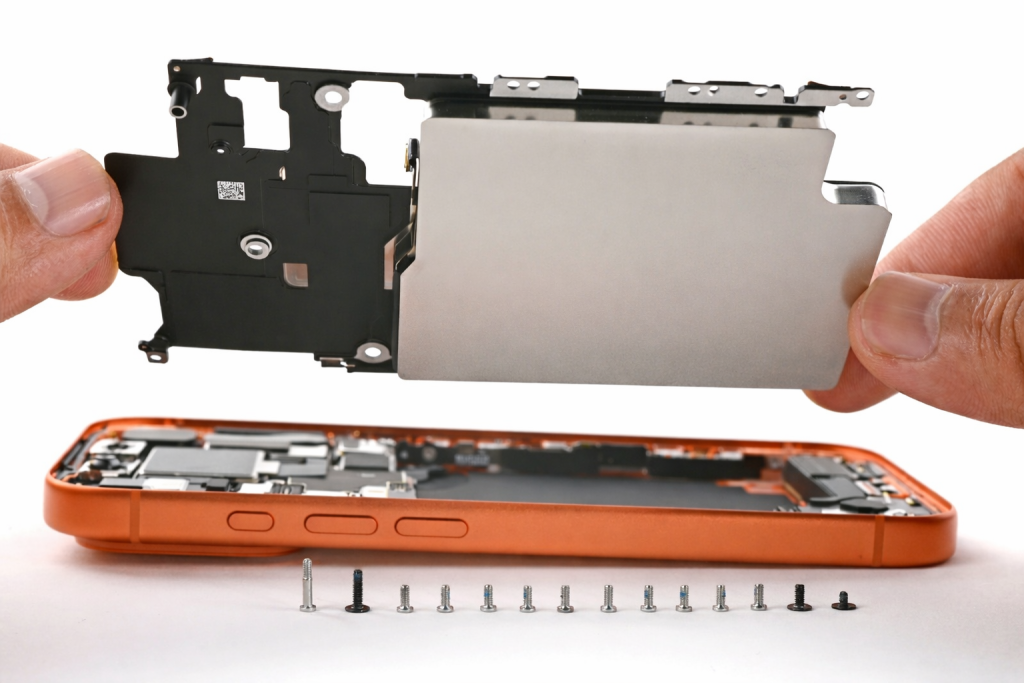
3. Battery Placement and Fixation Design

With the display removed, battery placement differences become apparent.

Compared tothe  iPhone 16

  • The battery sits in a slightly revised alignment within the cavity

  • Connector positioning is marginally adjusted

  • The adhesive area around the battery is more noticeable.

These changes suggest a refined mechanical fixation approach rather than a complete layout redesign.

4. Flexible Cable Routing: Minimize Slack and Hazards

Internal flex cable routing in the iPhone 17 reflects a clear push toward space efficiency.

Observed changes include:

  • Narrower routing channels

  • Shorter slack length

  • Straighter cable paths with fewer bends

Compared to the iPhone 16, cables occupy less unused volume and sit closer to surrounding shielding and structural elements.

5. Mid-Frame Architecture and Structural Reinforcement

Inspection of the mid-frame reveals subtle but important refinements.

The iPhone 17 mid-frame shows:

  • Reinforced internal ribs in load-bearing regions

  • Reduced material thickness in non-critical areas

  • Slightly adjusted screw positioning

These changes redistribute mechanical stress while maintaining overall rigidity.

6. Logic Board Density and Shielding Configuration

The logic board highlights Apple’s ongoing miniaturisation strategy.

In the iPhone 17:

  • Component density is increased

  • Shielding covers are more compact

  • Connector clusters are positioned closer together

Surface utilisation on the board appears more optimised compared to the iPhone 16 series.

7. Overall Internal Packaging Strategy

Looking at the device as a whole, a consistent internal packaging strategy emerges.

Across all subsystems, the iPhone 17 demonstrates:

  • Reduced internal spacing

  • Higher stacking efficiency

  • Tighter mechanical integration

Rather than introducing radical structural changes, Apple has refined existing designs to maximise internal space efficiency.

Conclusion

From a teardown and engineering perspective, the iPhone 17 represents a refinement-driven evolution over the iPhone 16 series. Structural changes focus on thinner assemblies, tighter tolerances, and more efficient internal packaging rather than major architectural redesign.

For anyone analysing Apple’s internal design progression, the iPhone 17 teardown confirms a continued emphasis on compactness, precision, and incremental optimisation.

Scroll to Top