


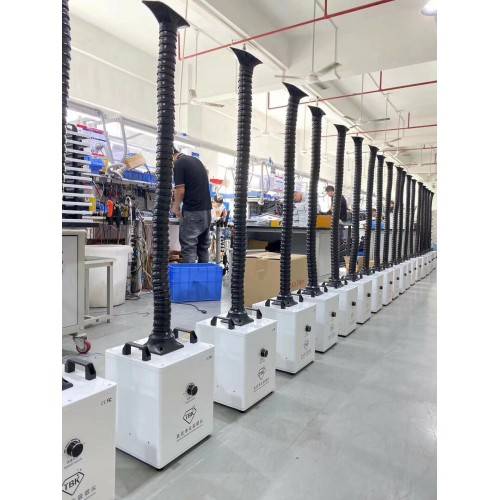
Two figures decide whether a bench-top fume extractor is adequate for a soldering bench, and neither of them is on the product page. The first is iron temperature: HSE guidance records that solder fume levels can triple between 250 °C and 400 °C. The second is a legal interval: an extraction system used to control exposure to rosin-based solder flux fume must be thoroughly examined and tested by a competent person at least every 14 months. A fume extractor is therefore not a purchase, it is a control measure with a maintenance obligation attached — and HSE classifies the small portable fan-and-filter bench units in this product’s category as fume dispersers, which is a weaker control than the name on the box suggests.
(Last modified date: October 2, 2026)
What does the law require of a soldering bench?
Control of exposure to rosin-based solder flux fume, to a high standard, under COSHH.
HSE’s leaflet on controlling health risks from rosin (colophony)-based solder flux fume is aimed at employers and is explicit that the fume is a common cause of occupational asthma and can also cause dermatitis. Because it can cause asthma, COSHH requires a higher standard of control: exposure must be reduced to as low a level as is reasonably practicable, below the workplace exposure limit. The leaflet sets out a priority order, and a bench-top unit is only one option within it.
| Priority | What it means on a repair bench |
|---|---|
| Eliminate | Use a process that does not generate the fume: mechanical jointing such as crimping, or conductive adhesives. |
| Substitute | Move to rosin-free or rosin-reduced fluxes. |
| Engineering controls | Local exhaust ventilation — a capturing hood, a ventilated bench enclosure, on-tip extraction or a downdraught bench. General ventilation and temperature-controlled irons support these but do not replace them. |
| Reduce the number exposed | Automate or enclose the process, and keep people who are not soldering out of the fume. |
| Personal protective equipment | Gloves, eye protection, coveralls and suitable respiratory protection, used as a last resort. HSE states that RPE should not be used as a replacement for LEV in production soldering. |
Read that order before shopping. A small portable filter unit is a reasonable answer to intermittent, low-volume work and a poor answer to a production bench, and choosing it for the wrong task is the failure this section is designed to prevent.
What is a bench-top fume extractor actually doing?
Drawing fume through a filter and returning most of the air to the room.
HSE describes this category as fume dispersers, also known as air displacement units or black boxes, and the description is deliberately cautious. The extractor pulls fume through a coarse carbon filter and blows the air out of the back of the unit. HSE’s testing found that the coarse carbon filters usually fitted to these units remove only a small proportion of the harmful constituents of the fume, so the exhaust still contains an appreciable concentration. The unit is useful for very intermittent, low-volume soldering where the discharge is not aimed at another person and the room has good general ventilation; HSE’s own label for the effect is dilution rather than capture.
Three practical consequences follow, and they are worth more than any filtration claim on a specification sheet:
- Position the nozzle so the fume is drawn away from the operator’s breathing zone rather than across it, and keep it close to the joint. HSE gives the capture distance for a moveable hood as roughly 1–2 hood diameters, about 50–100 mm, beyond which capture falls away.
- Site the unit so its exhaust does not blow at the person at the next bench. The unit is moving fume, not necessarily removing it.
- Treat the filter as a consumable with a maintenance schedule, not a permanent part. HSE notes that solder fume forms a sticky residue in pumps, fans and ductwork, which rapidly leads to poor extraction and premature failure.

Which extractor suits which bench?
Two live options, and the choice turns on volume and on where the air goes.
The TBK unit listed here is a bench-top machine with a flexible, fully rotating arm, designed to pull smoke away during maintenance work and usable alongside laser machines. That articulation is the feature that matters most in practice, because a fixed head that is 300 mm from the joint is not controlling anything. The alternative in the shop is a 2UUL carbon filtration unit, which is the same broad category of control in a smaller footprint.
| Bench | What HSE’s priority order suggests | Where a bench-top unit fits |
|---|---|---|
| Occasional repair, one technician, good general ventilation | Rosin-free flux, temperature-controlled iron, careful posture | Adequate as a supplement, provided the discharge is not aimed at anyone |
| Daily microsoldering, several hours a day | LEV designed for the task — enclosure, on-tip extraction or downdraught bench | A stop-gap only; HSE’s position is that RPE is not a substitute for LEV in production soldering |
| Laser work and desoldering alongside soldering | Extraction matched to the process and the enclosure | Useful for an articulated arm that can be repositioned as the work moves, with the filter treated as a consumable |
What does a compliant bench cost to run?
Work the obligation in, not just the purchase price.
Take a shop with two soldering positions running four hours a day, five days a week, using a bench-top unit at each and replacing filters every quarter at £18, with a thorough examination and test of both units once a year by a competent person at £120. The consumables run to £144 a year across the two benches, and the examination adds £120, so the annual figure is about £264 on top of the hardware — roughly £2.64 per bench per working week across a 50-week year.
That is a model with stated assumptions. Substitute your own filter interval, filter price and test cost and the number changes, but the shape of it does not: the unit is the cheap part, and the maintenance schedule and the 14-month examination are what make the control real.
What should be documented, and what should be asked of the supplier?
The paperwork is part of the control, not an afterthought.
- The risk assessment for the soldering task, naming who is exposed and for how long.
- The filter specification for the unit, so the replacement part number is known before it is needed.
- The manufacturer’s recommended maintenance schedule, which HSE refers to directly as the basis for keeping the unit working as intended.
- The record of the thorough examination and test, held for the period the regulations require.
- Information and training for the people soldering, including the early signs and symptoms of lung and skin reactions.
On the buying side, the questions to put to a supplier are the same as for any safety product: the filter type and replacement interval, the airflow figure at the nozzle, the spare parts list, and whether the unit is intended for intermittent or continuous use. The wider bench build-out is covered in mobile phone repair tools for beginners, and the case for and against a purpose-built extractor in this class is set out in laser soldering fume extractor: do you need one.
How do you set the bench up so the extraction actually works?
Four settings decide it, and HSE gives the numbers for the first.
- Capture distance. For a moveable capturing hood, HSE gives reliable capture at roughly one to two hood diameters — about 50–100 mm — beyond which efficiency falls away and fume escapes into the room. A nozzle parked 300 mm from the joint is a decoration.
- Repositioning. The hood has to move with the work. HSE states plainly that it should be repositioned whenever the solder generation point moves, which is what makes an articulated arm worth paying for over a fixed head.
- Discharge direction. The unit pulls fume through a filter and returns air to the room, so the exhaust must not be aimed at the next bench or at the operator’s own breathing zone.
- Make-up air. Extraction needs air to replace what it removes; in a closed room with no supply, the unit just stirs the same air. HSE lists general ventilation and make-up air as part of the assessment, not as an optional extra.
The other setting worth changing is the iron. HSE records that fume levels can triple between 250 °C and 400 °C, so a temperature-controlled iron set to the lowest workable temperature reduces what the extractor has to deal with in the first place.
What maintenance does a bench extractor need?
Three jobs, and the first one is the reason units quietly stop working.
- Clean the residue out of the airflow path. Solder fume leaves a sticky deposit that builds in tubes, fans and filters; HSE notes that this residue leads rapidly to poor extraction, premature fan failure and blocked ducting.
- Replace the filter on a schedule, not on a smell. The coarse carbon filters used in bench units remove only a small proportion of the harmful constituents, and a saturated one removes less. Knowing the part number before it is needed is part of buying the unit properly.
- Keep the examination record. Where the extraction is the control measure for rosin-based flux fume, the thorough examination and test by a competent person is required at least every 14 months. That record, plus the filter changes, is the evidence that the control is real.
What should the risk assessment cover?
Five items, which between them cover what an inspector would ask for.
- The task: what is soldered, how often, for how long, and with which flux.
- The people exposed, including anyone nearby who is not soldering — maintenance staff are the ones usually forgotten.
- The controls in priority order: substitution first, then extraction, then the way the work is positioned, and personal protection last.
- Training and information, so the people exposed can recognise the early signs of lung or skin reaction rather than only the smell of flux.
- Review, which HSE lists as an ongoing duty rather than a one-off document.
The leaflet these points come from is aimed at employers and is short; it is worth reading in full once and then keeping the checklist on the wall. Where gloves, eye protection or respiratory protection are used, they are the last line rather than the plan — HSE is explicit that RPE should not replace LEV in production soldering.
When is a bench-top unit not enough?
When the work stops being occasional.
HSE’s examples of proper controls for manual soldering are a ventilated bench-top enclosure, on-tip extraction, or a downdraught bench. It notes that enclosing the work can reduce exposure to zero where the soldering happens inside the enclosure, and that on-tip extraction — a narrow tube on the iron itself — works at any exposure level and is the choice for large or irregular workpieces. A small fan-and-filter unit sits below those in effectiveness: it dilutes rather than captures, which HSE says is acceptable for very intermittent, low-volume work with good general ventilation.
The honest framing for a shop is therefore about volume. One technician soldering occasionally is a bench-top unit and good habits; a bench producing repairs all day is an enclosure, tip extraction or a downdraught surface, with the bench-top unit as a supplement rather than the control. The difference in cost between the two is real — the TBK unit is listed at £232.91 and the smaller 2UUL carbon filtration unit at £87.17 — but it is small next to the cost of a diagnosis, and exposure control is a legal duty rather than an equipment upgrade.
What does health surveillance involve?
Not a medical check for everyone, but a defined route for the people who are exposed.
HSE’s position in the same leaflet is that employers should provide information on skin checks and, where necessary, appropriate health surveillance. In practice that means telling people what the early symptoms look like — a persistent cough, wheeze or breathlessness, or dermatitis on the hands — and having a route for them to report it. For a small shop, that is a conversation and a note in the file rather than an occupational health contract, but it is the part of the control package that catches the problem before it becomes an asthma diagnosis.
References
- HSE INDG249: controlling health risks from rosin (colophony)-based solder flux fume — the COSHH priority order, the 250–400 °C fume figure, capture distances, the 14-month examination interval, and HSE’s assessment of fume dispersers.
- HSE: health surveillance — when health surveillance for exposed workers is appropriate.
FAQ
Should I use a fume extractor when soldering?
Yes, if the work is anything more than occasional. Rosin-based solder flux fume is a common cause of occupational asthma, and COSHH requires exposure to be controlled as low as is reasonably practicable. HSE’s priority order starts with avoiding the fume and substituting rosin-free flux, and extraction is the engineering control that follows.
Is a bench-top fume extractor enough for a repair shop?
For intermittent, low-volume work in a well-ventilated room with the discharge aimed away from people, HSE treats this category as usable. For daily production soldering, HSE is clear that RPE is not a substitute for LEV, and that the small fan-and-filter units remove only a small proportion of the harmful constituents and so dilute rather than capture the fume.
How often does an extraction system need testing?
HSE states that there is a legal requirement for a thorough examination and test of LEV systems by a competent person at least every 14 months. All new or modified systems should also be commissioned and tested to confirm that they capture and remove the fume as specified.
Can you solder without a fume extractor?
Only where the risk assessment supports it. HSE notes that careful positioning of the operator together with adequate general ventilation may be sufficient for small-scale and very infrequent tasks that do not use rosin-based fluxes. For production soldering it states that LEV will be required in most cases.
How does iron temperature affect the fume?
Materially. HSE records that fume levels can triple as iron temperature rises from 250 °C to 400 °C, which is one of the reasons a temperature-controlled iron is part of the control package rather than a convenience.
Buy extraction as a control measure, not as an accessory. Digi4u stocks bench-top fume extractors and carbon filtration units alongside the irons, tips and consumables that make a soldering bench work.