

BGA Precision Soldering Technology: The Ultimate Guide to High-Reliability Microelectronics Repair
Need this part? We stock tested replacement parts with same-day UK dispatch and a 12-month warranty.

BGA rework is decided by the temperature profile, not by the iron. A ball grid array hides its joints underneath the package, so nothing can be inspected or touched after reflow — the only control the technician has is what happens in the ninety seconds before the solder melts. The ranges in this guide are the working window; the tooling to hold them starts at £119.99 for a 3-in-1 hot-air rework station.
(Last modified date: October 4, 2026)
Why BGA joints fail, and why they fail invisibly
A BGA package connects through an array of solder balls on its underside, so the entire joint is out of sight. That has two consequences that shape every technique in this article. First, a defect cannot be found by looking — only by symptoms, X-ray or a reflow that is known to have been correct. Second, the failure mechanisms are thermal: a ball that never fully melted is a cold joint that works until it is flexed, and a board heated unevenly warps while the solder is molten, which cracks joints that were fine before the work started.
The temperature window, and what happens outside it
The profile most benches work to is a preheat stage of roughly 150–180 °C followed by reflow at 220–245 °C, with the board supported underneath so both sides of the assembly are close in temperature. Those two numbers are not suggestions; they are the boundary between two failure modes. Below the window, solder does not fully liquefy and the joint is unreliable from the moment it is made. Above it, the laminate softens, pads lift and components that were not being worked on are exposed to a reflow cycle they were never specified for.
| Defect after rework | Usual cause | The control that prevents it |
|---|---|---|
| Cold joint that works, then fails | Peak temperature below the solder’s liquidus, or heat removed too early | Top and bottom heat together, with the peak held long enough for the whole package |
| Lifted pads | Too much heat, or force applied while the solder is still solid | Respect the upper limit; never lift a package before the alloy is molten |
| Board warp and cracked neighbours | One-sided heating and no support under the PCB | Preheat both sides, support the board, keep it still through reflow |
| Voids and bridges | Flux applied by eye, or paste quantity wrong for the ball pitch | Stencil the paste, use the correct ball size for the package |
The tooling that decides the result
Four items do most of the work, and each has a purpose that is easy to skip until it matters. A hot-air station with adjustable airflow handles localised heating; a preheater or bottom-heat plate brings the whole board up so the delta across the assembly is small; reballing stencils and the correct solder balls rebuild the package, with ball sizes typically between 0.25 mm and 0.5 mm depending on the chip; and magnification of 10×–40× is what turns pad inspection from guesswork into a measurement.
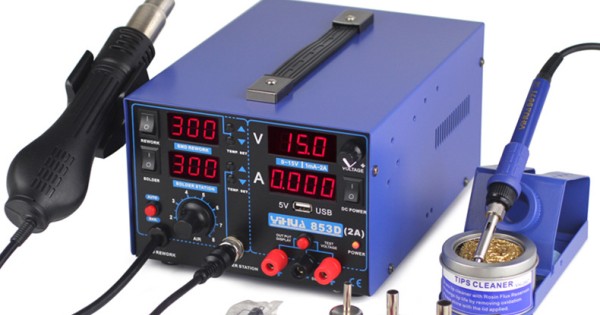
On Digi4u’s current listings that is the YIHUA 853D 3-in-1 station at £119.99, the Mechanic UFO planting-paste stencil set at £17.99, and the smaller iPhone 11–13 stencil set at £11.66. A V1S programmer at £101.66 is not part of the soldering itself, but on iPhone work it is what allows the board to be tested properly after the reflow.
What a rework bench costs to set up, and to run
A model with stated assumptions. The equipment prices are live listings; the consumable and labour figures are yours to replace.
Station, stencils and a magnifier come to roughly £160–£200 before a bottom-heat plate and a microscope. Add solder balls, flux and cleaning agents at around £1.50 per reworked package, and 45–75 minutes of skilled bench time per board at a £45 rate — about £34–£56 of labour.
A single-board rework therefore costs roughly £36–£58 in materials and time once the bench exists. If the job is invoiced at £90 the contribution is around £32–£54. The tooling is repaid over the first handful of boards; what is not paid back quickly is a failed rework, because a board that has been cooked is usually a board that has to be replaced.
The extraction rule that applies to every reflow
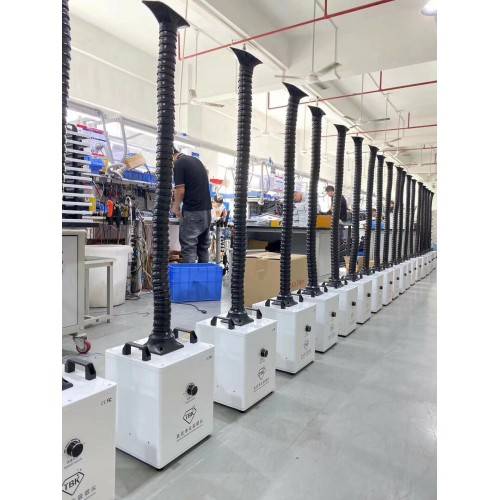
Reflow produces flux fume, and the controls are not a matter of preference. The HSE leaflet on rosin-based solder flux fume sets them out: capture the fume at source, maintain the extraction so the filter keeps working, and keep the discharge away from the operator’s breathing zone. A bench that produces a clean joint and a headache for the technician has solved half the job.
What to ask a tooling supplier for
Four answers separate a station that can hold a profile from one that merely gets hot. The achievable temperature range and its accuracy at the nozzle; the airflow control resolution, because a coarse dial cannot hold a steady reflow; the availability of spare nozzles, heaters and thermocouples; and the calibration procedure for the temperature sensor. Ask for all four before buying, and ask for the ball diameter used by the stencils, because that number has to match the package being reworked.
How to know the rework actually worked
A board that boots is not proof of a good joint, and a board that fails is not proof of a bad one. Three checks give a defensible answer. The electrical check is the minimum: does the function the package controls behave correctly at temperature as well as at room temperature, because a marginal joint often works cold and opens when warm. The second is a visual check of the surrounding area at magnification, looking for displaced components and solder splatter rather than at the package itself. The third, where X-ray access exists or can be rented locally, is the only way to see the balls; a shop doing regular rework on high-value boards should price that access rather than assume the first two checks are equivalent.
What none of the three replaces is a repeatable profile. If the same board type is reworked with the same top and bottom settings every time, a failure can be diagnosed by changing one variable; if settings drift between jobs, every failure is a fresh investigation.
References
- HSE INDG249: controlling health risks from rosin-based solder flux fume — capture at source, filter maintenance, operator exposure.
- Apple: Self Service Repair — genuine parts, tool rental and the repair manuals Apple publishes for its own boards.
- Consumer Rights Act 2015 — satisfactory quality and reasonable care when work is sold to a consumer.
FAQ
What temperature should BGA reflow be run at?
A preheat stage of roughly 150–180 °C followed by reflow at 220–245 °C, with bottom heat so both sides of the board are close in temperature. Below that window the joints are unreliable, above it pads lift and the laminate softens.
Why do my BGA joints fail a week after rework?
Almost always because the peak was too low or was held for too short a time, so some balls never fully melted. A cold joint passes a test and fails under flex, which is why the profile matters more than how the joint looks.
Do I need a bottom-heat preheater?
For anything larger than a small package, yes. Top heat alone creates a temperature difference across the board, and that difference is what causes warping and cracks in parts of the assembly you were not working on.
What magnification is needed for BGA work?
Ten to forty times is the working range: enough to inspect pad condition, check ball alignment and spot micro-cracks that are invisible at bench distance. Below that you are reflowing without being able to verify the surface you are working on.
Do I need extraction on a rework bench?
Yes. Reflow produces flux fume, and the HSE guidance is to capture it at source, keep the filter working, and keep the discharge away from the operator. It applies to every bench process that produces fume, not only to production lines.
Hold the profile, then repeat it. Rework stations, stencils and the consumables that go with them are listed in the Digi4u tool range.